

Preview for Kara’s review. Educational draft · clinical approval pending.
A menstrual cycle is not simply the days when you have your period. Your period is only one part of an entire reproductive cycle, and understanding the rest of it makes a lot of fertility information suddenly make sense.
Think of the cycle as three broad events: a follicle develops, an egg is released (ovulation), and then the body prepares the uterine lining in case an embryo implants. If pregnancy doesn’t happen, the lining is shed and a new cycle begins.
Day one is your period

Cycle day one is normally counted as the first day of bleeding. During the first part of the cycle, hormones encourage a group of follicles in the ovaries to grow. Usually one becomes dominant and continues to mature.
Ovulation
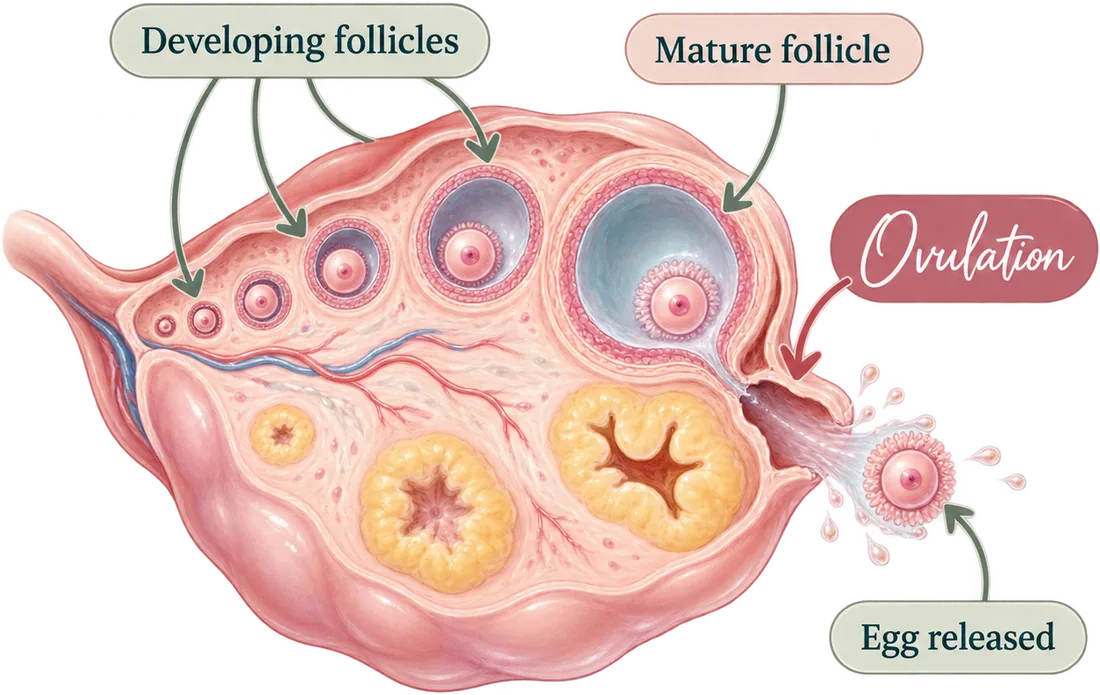
A rise in luteinising hormone (LH), often called the LH surge, triggers the mature follicle to release its egg. This is ovulation. Afterwards, the follicle becomes the corpus luteum, which produces progesterone to support the uterine lining.
Your fertile window
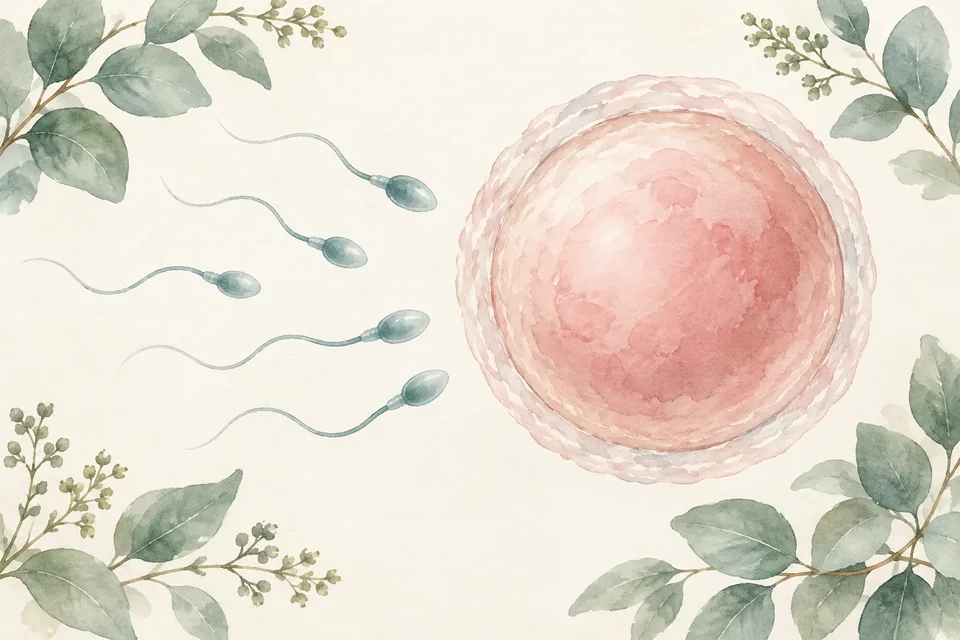
A common misconception is that there is only one day each month when pregnancy can happen. Sperm can remain viable in the reproductive tract for a number of days, while the egg has a much shorter window after ovulation. That is why professional guidance describes a fertile window: a span of around six days ending on the day of ovulation.
Not everyone has a 28-day cycle

A normal menstrual cycle can be anywhere from 24 to 38 days, and it’s normal for it to vary a little from month to month. Ovulation doesn’t always happen on day 14: in a study of more than 600,000 cycles, the timing of ovulation varied a lot between women and between cycles. Illness, severe stress, big changes in weight and very intense exercise can delay ovulation or stop it for a while, and so can hormonal conditions such as PCOS (now also called PMOS). If your cycles are very irregular, absent, or longer than 38 days, it’s worth talking to your doctor.
Predicting ovulation vs confirming it

An app estimates ovulation from past dates. A urinary LH test detects a hormonal signal that usually comes shortly before ovulation. In a medical setting, blood tests or ultrasound may be used. Predicting ovulation and confirming it are not the same thing.
If something doesn’t feel right

Occasionally an embryo implants outside the uterus, usually in a fallopian tube. This is called an ectopic pregnancy, and it can be serious. If you might be pregnant and have pain low down on one side of your tummy, vaginal bleeding or a brown, watery discharge, or pain in the tip of your shoulder, get medical advice the same day, even if a pregnancy test is negative. If the pain is sudden and severe, or you feel faint or very dizzy, go to your nearest emergency unit straight away, or call an ambulance on 10177 (112 from a cellphone).
Myth vs evidence
“You can only get pregnant on one day each month.”
Think fertile window, not fertility moment. Intercourse in the days before ovulation can still result in fertilisation.
“If you have periods, you must be ovulating.”
Regular, predictable cycles are often associated with ovulation, but a bleed on its own doesn’t confirm that ovulation happened in that cycle.
- Is my cycle length or pattern anything to look into?
- Do I have any reason to be concerned about whether I am ovulating regularly?
- Would tracking LH or other signs be useful in my situation?
Words you may hear
- Follicle
- A small fluid-filled sac in the ovary that contains a developing egg.
- LH surge
- A rise in luteinising hormone that triggers ovulation.
- Corpus luteum
- The structure the follicle becomes after ovulation; it produces progesterone.
- Luteal phase
- The part of the cycle after ovulation and before the next period.
Human biology doesn’t run on a phone calendar. Think “a biological window around ovulation”, not one exact hour.
Watch with Kara
Videos on this topic are coming to the channel:
- How Ovulation Actually Works
- How Do You Know If You’re Ovulating?
- Understanding Your Fertile Window
- How the Menstrual Cycle Works
Male fertility belongs in the same conversation. These illustrated guides pair with this topic:

Want the foundations in one place? The free Fertility Starter Guide covers ten things everyone should understand about their fertility.
Sources 6 studies and guidelines Show the research
- ASRM Practice Committee (2022). Optimizing natural fertility: a committee opinion. Fertility and Sterility.
- NICE (2026). Fertility problems: assessment and treatment (guideline NG257).
- Bull et al. (2019). Real-world menstrual cycle characteristics of more than 600,000 menstrual cycles. NPJ Digital Medicine.
- Wilcox, Dunson & Baird (2000). The timing of the “fertile window” in the menstrual cycle. BMJ.
- Gibbons et al. (2023). Timed intercourse for couples trying to conceive. Cochrane Database of Systematic Reviews.
- Speroff, Glass & Kase (1999). Clinical gynecologic endocrinology and infertility, 6th edition (chapter on amenorrhoea).